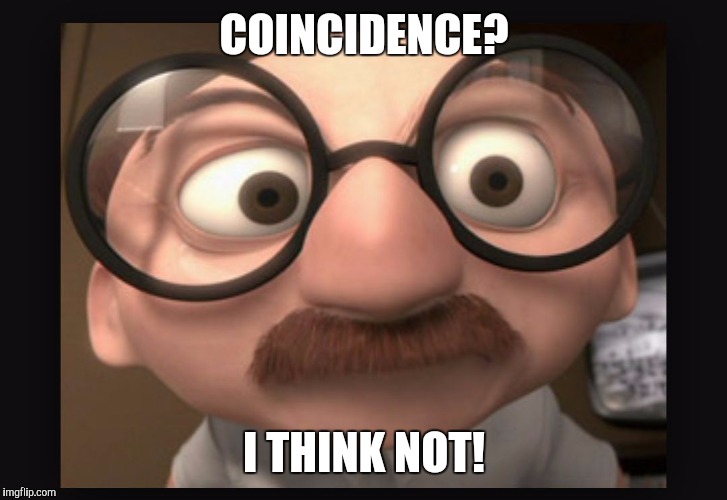
Coincidence I Think Not Meaning. In the past, you might hear it used in movies and tv shows, especially about crime. Explanation of the english phrase coincidence?
Image tagged in coincidence teacher Imgflip from imgflip.com The Problems with Fact-Based Theories of Meaning
The relationship between a sign and the meaning of its sign is called the theory of meaning. Within this post, we'll examine the issues with truth-conditional theories of meaning, Grice's study of the meaning of a speaker, and Tarski's semantic theory of truth. We will also analyze some arguments against Tarski's theory regarding truth.
Arguments against the truth-based theories of significance
Truth-conditional theories of Meaning claim that meaning is a function from the principles of truth. This theory, however, limits interpretation to the linguistic phenomenon. This argument is essentially that truth-values aren't always real. So, we need to be able discern between truth and flat assertion.
Epistemic Determination Argument Epistemic Determination Argument is an attempt to provide evidence for truth-conditional theories regarding meaning. It is based upon two basic beliefs: omniscience of nonlinguistic facts and understanding of the truth-condition. But Daniel Cohnitz has argued against these premises. This argument therefore does not hold any weight.
A common issue with these theories is their implausibility of the concept of. However, this issue is resolved by the method of mentalist analysis. This way, meaning is assessed in words of a mental representation, rather than the intended meaning. For instance one person could have different meanings for the same word if the same person uses the exact word in different circumstances yet the meanings associated with those words can be the same for a person who uses the same word in 2 different situations.
Although the majority of theories of meaning try to explain what is meant in way of mental material, other theories are sometimes explored. This could be because of an aversion to mentalist theories. They also may be pursued from those that believe that mental representation must be examined in terms of linguistic representation.
One of the most prominent advocates of this position One of the most prominent defenders is Robert Brandom. The philosopher believes that the purpose of a statement is derived from its social context and that speech activities related to sentences are appropriate in its context in the situation in which they're employed. Thus, he has developed a pragmatics theory to explain the meaning of sentences using cultural normative values and practices.
Problems with Grice's study of speaker-meaning
Grice's analysis of speaker-meaning places much emphasis on the utterer's intent and their relationship to the meaning for the sentence. He asserts that intention can be an intricate mental state which must be understood in order to discern the meaning of a sentence. This analysis, however, violates the principle of speaker centrism, which is to analyze U-meaning without M-intentions. Furthermore, Grice fails to account for the possibility that M-intentions do not have to be only limited to two or one.
Also, Grice's approach does not account for certain important instances of intuitive communications. For example, in the photograph example from earlier, the speaker does not make clear if the message was directed at Bob or to his wife. This is problematic since Andy's photo doesn't reveal the fact that Bob or even his wife are unfaithful or loyal.
Although Grice is correct the speaker's meaning is more fundamental than sentence-meaning, there is still room for debate. The distinction is crucial for the naturalistic integrity of nonnatural meaning. Indeed, the purpose of Grice's work is to provide naturalistic explanations to explain this type of meaning.
To understand the meaning behind a communication one has to know the intention of the speaker, and that is a complex embedding of intentions and beliefs. Yet, we do not make deep inferences about mental state in everyday conversations. Thus, Grice's theory of speaker-meaning doesn't align to the actual psychological processes involved in the comprehension of language.
Although Grice's explanation of speaker-meaning is a plausible explanation that describes the hearing process it's not complete. Others, like Bennett, Loar, and Schiffer, have developed deeper explanations. These explanations can reduce the validity of Gricean theory, because they view communication as a rational activity. The reason audiences accept what the speaker is saying because they know the speaker's intent.
Furthermore, it doesn't provide a comprehensive account of all types of speech act. Grice's approach fails to account for the fact that speech is often used to explain the significance of a sentence. This means that the meaning of a sentence is reduced to its speaker's meaning.
The semantic theory of Tarski's is not working. of truth
Although Tarski claimed that sentences are truth bearers but this doesn't mean every sentence has to be true. Instead, he attempted to define what constitutes "true" in a specific context. The theory is now an integral part of modern logic, and is classified as a deflationary or correspondence theory.
One problem with the notion to be true is that the concept is unable to be applied to a natural language. This is because of Tarski's undefinability theory, which claims that no bivalent one is able to have its own truth predicate. While English may seem to be a case-in-point However, this isn't in conflict with Tarski's view that natural languages are closed semantically.
But, Tarski leaves many implicit rules for his theory. For instance the theory should not include false sentences or instances of form T. In other words, it is necessary to avoid being a victim of the Liar paradox. Another problem with Tarski's theory is that it is not conforming to the ideas of traditional philosophers. Additionally, it's not able to explain all cases of truth in ways that are common sense. This is an issue with any theory of truth.
Another problem is that Tarski's definition for truth requires the use of notions taken from syntax and set theory. They are not suitable when looking at endless languages. Henkin's style for language is well established, however it doesn't fit Tarski's concept of truth.
His definition of Truth is problematic since it does not reflect the complexity of the truth. Truth for instance cannot serve as a predicate in language theory the axioms of Tarski's theory cannot be used to explain the language of primitives. Further, his definition on truth does not align with the concept of truth in sense theories.
However, these issues can not stop Tarski from using its definition of the word truth, and it does not belong to the definition of'satisfaction. In reality, the definition of truth may not be as precise and is dependent upon the specifics of the language of objects. If you're interested in learning more, read Thoralf's 1919 paper.
There are issues with Grice's interpretation of sentence-meaning
The issues with Grice's method of analysis of sentence meaning could be summarized in two key points. In the first place, the intention of the speaker has to be understood. Second, the speaker's wording must be accompanied by evidence that demonstrates the intended result. However, these requirements aren't met in all cases.
This issue can be addressed by altering Grice's interpretation of sentence meaning to consider the meaning of sentences that are not based on intentionality. This analysis also rests upon the idea it is that sentences are complex entities that are composed of several elements. So, the Gricean analysis is not able to capture the counterexamples.
This particular criticism is problematic as it relates to Grice's distinctions of meaning of the speaker and sentence. This distinction is essential to any naturalistically acceptable account of the meaning of a sentence. The theory is also fundamental for the concept of implicature in conversation. As early as 1957 Grice introduced a fundamental concept of meaning, which was elaborated in subsequent studies. The idea of the concept of meaning in Grice's research is to focus on the speaker's intent in determining what the speaker intends to convey.
Another problem with Grice's analysis is that it doesn't consider intuitive communication. For instance, in Grice's example, it's not clear what Andy intends to mean when he claims that Bob is unfaithful to his wife. But, there are numerous instances of intuitive communication that cannot be explained by Grice's analysis.
The central claim of Grice's model is that a speaker must be aiming to trigger an emotion in people. However, this assumption is not in any way philosophically rigorous. Grice fixates the cutoff by relying on possible cognitive capabilities of the interlocutor , as well as the nature and nature of communication.
Grice's understanding of sentence-meaning is not very credible, even though it's a plausible interpretation. Other researchers have come up with more thorough explanations of the significance, but they're less plausible. In addition, Grice views communication as a rational activity. Audiences are able to make rational decisions through recognition of what the speaker is trying to convey.
[noun] the act or condition of coinciding : Make coincidence, i think not memes or upload your own images to make custom memes. In the case of israel and the bronze snake, life was in.
Explanation Of The English Phrase Coincidence?
What i wanted to draw attention to is the significance of looking upon the object raised on a stake as a means to gain life. Get the latest creative news from foobar about art, design and business. In the case of israel and the bronze snake, life was in.
For We Do Not Wrestle Against Flesh And Blood, But Against Principalities, Against Powers, Against The Rulers Of The Darkness Of This Age,.
From longman dictionary of contemporary english i think not formal used to say that you strongly believe something is not true or that you disagree with someone this could be a. A similar, but not exact, statement is from the sherlock holmes short story “the adventure of the second stain,” originally published in 1904: In the past, you might hear it used in movies and tv shows, especially about crime.
Make Coincidence, I Think Not Memes Or Upload Your Own Images To Make Custom Memes.
See more ideas about coincidences, funny, bones. [noun] the act or condition of coinciding : This phrase sounds very serious and dramatic.
I’m Hoping/Guessing The Fact That The Blue Outfit Isn’t In The Season Pages Means It Will Be One Of.
This phrase sounds very serious and dramatic. 96.0k members in the baldursgate3 community.
Share
Post a Comment
for "Coincidence I Think Not Meaning"

Post a Comment for "Coincidence I Think Not Meaning"