Meaning Of Stephanie In Hebrew. The male form is stephen. The girl's name stephanie is of greek origin, and its meaning is crown, garland.
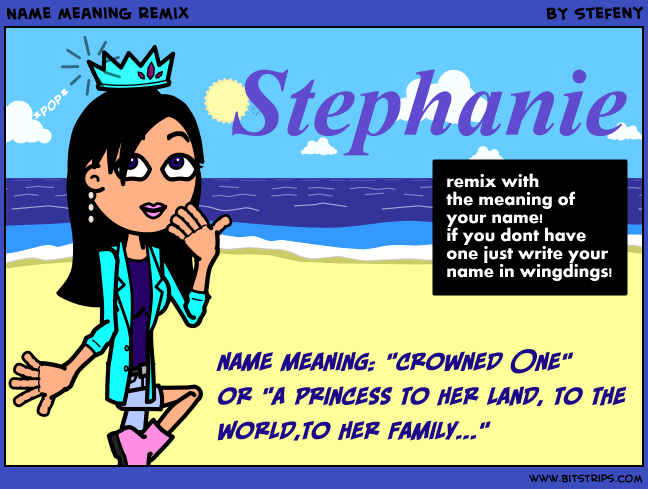
Name meaning remix Bitstrips from bitstrips.com The Problems With Truth-Conditional Theories of Meaning
The relationship between a sign along with the significance of the sign can be called"the theory that explains meaning.. This article we'll look at the difficulties with truth-conditional theories regarding meaning, Grice's assessment of speaker-meaning, as well as The semantics of Truth proposed by Tarski. We will also look at arguments against Tarski's theory of truth.
Arguments against truth-based theories of meaning
Truth-conditional theories for meaning say that meaning is the result in the conditions that define truth. But, this theory restricts understanding to the linguistic processes. It is Davidson's main argument that truth-values aren't always the truth. Thus, we must recognize the difference between truth-values and a simple statement.
It is the Epistemic Determination Argument is an attempt to defend truth-conditional theories of meaning. It is based on two fundamental notions: the omniscience and knowledge of nonlinguistic facts and the understanding of the truth-condition. But Daniel Cohnitz has argued against these assumptions. Therefore, this argument has no merit.
Another problem that can be found in these theories is the impossibility of meaning. However, this concern is solved by mentalist analysis. This way, meaning can be examined in regards to a representation of the mental instead of the meaning intended. For example that a person may find different meanings to the similar word when that same person is using the same phrase in both contexts, however, the meanings for those terms could be the same if the speaker is using the same phrase in various contexts.
Although the majority of theories of reasoning attempt to define meaning in terms of mental content, other theories are sometimes explored. This could be due to suspicion of mentalist theories. They are also favored as a result of the belief that mental representation needs to be examined in terms of linguistic representation.
Another significant defender of the view Another major defender of this view is Robert Brandom. The philosopher believes that the meaning of a sentence is determined by its social context and that the speech actions which involve sentences are appropriate in what context in the setting in which they're used. Thus, he has developed an understanding of pragmatics to explain sentence meanings based on traditional social practices and normative statuses.
Problems with Grice's study of speaker-meaning
Grice's analysis of speaker-meaning puts much emphasis on the utterer's intention and its relation to the meaning to the meaning of the sentence. He asserts that intention can be something that is a complicated mental state which must be understood in order to interpret the meaning of the sentence. But, this method of analysis is in violation of speaker centrism because it examines U meaning without considering M-intentions. Furthermore, Grice fails to account for the fact that M-intentions don't have to be limitless to one or two.
Moreover, Grice's analysis doesn't account for critical instances of intuitive communication. For instance, in the photograph example of earlier, the individual speaking doesn't make it clear whether it was Bob or his wife. This is problematic because Andy's image doesn't clearly show the fact that Bob as well as his spouse is unfaithful , or loyal.
Although Grice is correct that speaker-meaning is more crucial than sentence-meaning, there's still room for debate. Actually, the distinction is vital for the naturalistic reliability of non-natural meaning. Indeed, the purpose of Grice's work is to offer naturalistic explanations that explain such a non-natural meaning.
To understand the meaning behind a communication we must be aware of the speaker's intention, as that intention is an intricate embedding and beliefs. Yet, we do not make difficult inferences about our mental state in normal communication. So, Grice's understanding of meaning-of-the-speaker is not in accordance with the actual mental processes involved in communication.
While Grice's story of speaker-meaning is a plausible description to explain the mechanism, it's still far from complete. Others, including Bennett, Loar, and Schiffer have come up with more thorough explanations. These explanations, however, have a tendency to reduce the validity to the Gricean theory since they view communication as an act of rationality. In essence, the audience is able to believe that a speaker's words are true as they comprehend the speaker's motives.
Moreover, it does not cover all types of speech act. Grice's theory also fails to include the fact speech is often employed to explain the meaning of a sentence. This means that the nature of a sentence has been reduced to the meaning of the speaker.
Problems with Tarski's semantic theory of truth
While Tarski claimed that sentences are truth-bearing But this doesn't imply that any sentence is always truthful. Instead, he tried to define what constitutes "true" in a specific context. His theory has since become a central part of modern logic and is classified as a deflationary theory, also known as correspondence theory.
One problem with the theory for truth is it cannot be applied to natural languages. This is due to Tarski's undefinability theorem, which states that no bivalent language is able to hold its own predicate. While English may seem to be an an exception to this rule This is not in contradiction with Tarski's view that natural languages are closed semantically.
However, Tarski leaves many implicit limitations on his theory. For instance the theory cannot contain false statements or instances of the form T. This means that theories should not create it being subject to the Liar paradox. Another problem with Tarski's theory is that it is not at all in line with the theories of traditional philosophers. In addition, it is unable to explain each and every case of truth in terms of the common sense. This is an issue for any theory about truth.
Another issue is that Tarski's definition calls for the use of concepts drawn from set theory as well as syntax. These are not appropriate in the context of infinite languages. Henkin's approach to language is well-founded, however it doesn't support Tarski's concept of truth.
A definition like Tarski's of what is truth challenging because it fails to take into account the complexity of the truth. In particular, truth is not able to serve as an axiom in the interpretation theories, and Tarski's axioms cannot clarify the meanings of primitives. Further, his definition on truth is not compatible with the concept of truth in interpretation theories.
However, these limitations should not hinder Tarski from using an understanding of truth that he has developed and it doesn't qualify as satisfying. In reality, the definition of truth may not be as than simple and is dependent on the specifics of the language of objects. If you want to know more, take a look at Thoralf Skolem's 1919 paper.
A few issues with Grice's analysis on sentence-meaning
The problems that Grice's analysis has with its analysis of meaning of sentences can be summed up in two main points. First, the intention of the speaker needs to be recognized. Additionally, the speaker's speech must be supported with evidence that confirms the intended result. However, these conditions aren't fulfilled in every instance.
This problem can be solved by changing the way Grice analyzes meaning of sentences, to encompass the meaning of sentences that lack intention. The analysis is based upon the idea sentence meanings are complicated and contain a variety of fundamental elements. In this way, the Gricean analysis isn't able to identify any counterexamples.
This is particularly problematic when you consider Grice's distinction between speaker-meaning and sentence-meaning. This distinction is crucial to any naturalistically credible account of the meaning of a sentence. It is also necessary to the notion of implicature in conversation. In 1957, Grice presented a theory that was the basis of his theory, which was refined in later research papers. The idea of meaning in Grice's research is to look at the speaker's intention in determining what the speaker intends to convey.
Another issue with Grice's analysis is that it doesn't include intuitive communication. For example, in Grice's example, it's not clear what Andy uses to say that Bob is not faithful towards his spouse. However, there are plenty of different examples of intuitive communication that are not explained by Grice's analysis.
The main argument of Grice's study is that the speaker has to be intending to create an effect in an audience. However, this assumption is not an intellectually rigorous one. Grice adjusts the cutoff according to indeterminate cognitive capacities of the interlocutor and the nature of communication.
Grice's argument for sentence-meaning is not very plausible, however it's an plausible explanation. Other researchers have developed more specific explanations of meaning, but they're less plausible. Furthermore, Grice views communication as an activity that can be rationalized. Audiences make their own decisions by being aware of an individual's intention.
סטפני hebrew discuss this stephanie english translation with the community: It’s been a royal name, used for. Stephanie is a feminine name derived from the ancient greek name, stephanos (or stephanas), which means “crown”.
English Gematria, Hebrew Gematria And Jewish Gematria And.
Stephanie or stefanie is a female name that comes from the greek name στέφανος (stefanos) meaning crown. I just wanted to help, if help it is. The male form is stephen.
Stephanie Or Stefanie Is A Female Name That Comes From The Greek Name Στέφανος (Stefanos) Meaning Crown.
Forms of stephanie in other languages include. Stephanie is a greek name meaning crown. Stephanie is a feminine name derived from the ancient greek name, stephanos (or stephanas), which means “crown”.
The Spiritual Meaning Of The Name Stephanie Can Also Mean “The.
Stephanie, as you can probably imagine, is a feminized version of the classic boys’ baby name, stephen. It shares the same meaning as stephen, too—crown. The male form is stephen.forms of stephanie in other languages include the german.
The Diamond Is The Auspicious Gemstone For Those Named Stephanie.
51 rows value of stephanie in gematria is 318, online gematria calculator with same phrases values search and words. Usually light brown eyes, they can stare into your soul and is their way of making you do what they want. The name of the first christian martyr was.
Conclusion On Stephanie In Hebrew.
It is of greek origin, and the meaning of stephanie is garland, crown. Stephanie is a female name that comes from the greek name στέφανος (stephanos) meaning crown. Stephanie doesn’t just mean “crown.” throughout history, many queens, queen consorts, princesses and duchesses have held the name, ranging from stephanie, queen of navarre in.
Share
Post a Comment
for "Meaning Of Stephanie In Hebrew"

Post a Comment for "Meaning Of Stephanie In Hebrew"